You know that person in your life who "has everything"? The one where every birthday becomes a low-grade panic attack because you've already cycled through candles, wine, and that one novelty mug they smiled politely at?
Here's the thing. The most unforgettable gift you've ever received probably wasn't the most expensive one. It was the one that made you think, "How did they know?" That gut-punch of feeling truly seen by another human being - that's not luck. That's psychology.

The science is clear: the gifts people keep for decades, the ones that sit on their desk or ride along on their keychain for years, are rooted in specific neurochemical and behavioral mechanisms. They're not about price tags. They're about cognitive effort, emotional resonance, and identity.
This article breaks down the actual neuroscience behind why personalized gifts work so well, compares them head-to-head against standard store-bought options, and reveals the custom gift ideas that leverage all of this psychology to make someone feel genuinely understood. Not "gift card" understood. Actually understood.
🧠 The Science Behind Meaningful Gifts
Most gift guides skip straight to product recommendations. That's backwards. If you understand why certain gifts trigger deeper emotional responses than others, you'll never waste money on a generic present again.
Signaling Theory and Cognitive Effort
Evolutionary psychologists have a concept called "signaling theory." In short: gifts are signals. They communicate the depth of your investment in a relationship.
Here's where it gets interesting. A $200 designer wallet requires exactly one resource from you: money. You walked into a store, pointed at something shiny, and swiped your card. That's low cognitive effort. It signals, "I can afford things," which, frankly, nobody asked.
A personalized gift, on the other hand, requires thought. You had to recall a specific memory, choose a meaningful photo, decide on a style, and plan the timing. That process - the thinking, the choosing, the caring enough to invest your mental energy - sends a much louder signal than any luxury logo ever could. It says, "I pay attention to who you are."
The Oxytocin Connection
Your brain processes generic gifts and personalized gifts very differently.
A standard gift - a nice scarf, a box of chocolates - activates your dopamine system. You get a quick hit of pleasure. Nice. But it fades fast, usually within hours. It's the neurochemical equivalent of a sugar rush.
Personalized gifts do something different. When a recipient feels deeply understood by a gift, the brain releases oxytocin, sometimes called the "bonding hormone." According to Dr. Emiliana Simon-Thomas, science director at UC Berkeley's Greater Good Science Center, giving activates pathways that release oxytocin, which signals trust, safety, and connection. Unlike a pure dopamine spike, oxytocin's effects are sustained longer and are present during every phase - from the anticipation of giving, to the moment of unwrapping, to the memory triggered weeks later.
A 2007 study published in PLOS ONE by neuroeconomist Paul Zak and colleagues demonstrated this powerfully. Participants who received oxytocin were 80% more generous than those given a placebo, and the researchers found that oxytocin and altruism together predicted nearly half of all interpersonal variation in generosity. The takeaway? The bonding chemistry triggered by thoughtful giving isn't a soft, fuzzy concept. It's measurable. It's real. And personalized gifts are uniquely positioned to trigger it because they require the giver to emotionally identify with the recipient.
The Endowment Effect and Identity
Behavioral economics gives us one more piece of the puzzle: the endowment effect. People assign higher value to objects they feel psychologically "own" - not just in the legal sense, but in the identity sense.
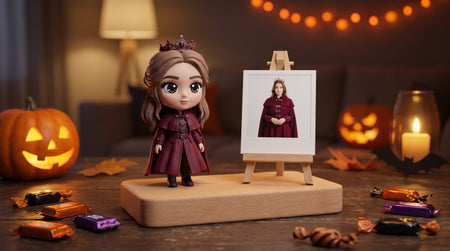
A generic coffee mug is a coffee mug. You could replace it tomorrow and feel nothing. But a custom figurine that captures the exact messy bun you wore on your wedding day? That's not an object anymore. It's a piece of your story. It becomes an extension of who you are.
This is why personalized items almost never get thrown away. They're psychologically expensive to discard because getting rid of them feels like erasing a part of your own identity. That's the real longevity hack of customization - it doesn't just sit on a shelf, it becomes theirs in a way mass-produced items never can.

📊 Store-Bought vs. Personalized Gifts: A Psychological Breakdown
Let's put this side by side. When you compare the two categories across the metrics that actually matter for long-term emotional impact, the gap is stark.
| Metric | Standard Store-Bought Gifts | Personalized / Custom Gifts |
|---|---|---|
| Effort Level | Low - requires money, minimal thought | High - requires knowledge of recipient, planning, creative decisions |
| Emotional Impact | Short dopamine spike, fades quickly | Sustained oxytocin release, deepens emotional bond over time |
| Uniqueness | Mass-produced, identical to thousands of units | One-of-one, impossible to replicate |
| Longevity | Often re-gifted, donated, or forgotten | Kept for years, becomes part of personal identity |
The pattern is obvious. Customization shifts the entire value equation away from "how much did this cost?" toward "how much do they know me?" And that shift is exactly where the emotional magic lives.
A 2024 Statista survey of over 1,000 U.S. adults found that roughly half of Gen Z and millennial consumers said they were more likely to buy or give a personalized gift compared to the previous holiday season. Younger generations aren't just open to personalization - they're actively seeking it. The era of defaulting to a gift card because "they can pick what they want" is fading. People want to feel chosen, not convenient.
🎒 The "Portable Memory" Concept: Why Everyday Items Win
There's a psychological principle borrowed from classical conditioning that most gift-givers overlook entirely.
Think about it this way. A custom painting is beautiful. Genuinely. But it hangs on one wall in one room. You see it when you happen to walk past, and eventually your brain starts filtering it out like wallpaper. Psychologists call this "habituation" - repeated exposure to a static stimulus reduces your emotional response to it.
Now compare that to a portable gift. A custom keychain. A bag charm. A small figurine clipped to a backpack.
This is why the best custom gift ideas aren't always the biggest or most expensive ones. They're the ones that embed themselves into daily routines, quietly reinforcing the emotional bond between giver and recipient dozens of times per week.
✨ Best Custom Gift Ideas: The 3D Keychain Revolution
So if portable, personalized, high-cognitive-effort gifts are the psychological gold standard, what actually fits that description?
Most "personalized" gifts on the market are, let's be honest, underwhelming. A name laser-etched onto a wooden cutting board. A photo printed on a phone case that peels off after three months. These check the "custom" box technically, but they don't deliver the kind of emotional punch we've been talking about.
This is where 3D-printed figurines and keychains have quietly changed the game, and where SnapFig's approach stands apart.
Custom 3D Avatar Keychains for Friends and Partners
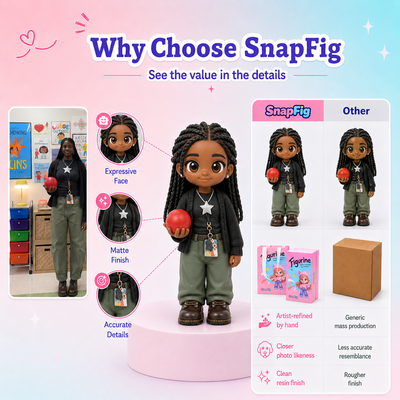
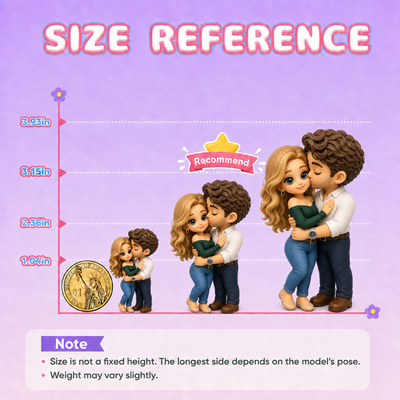
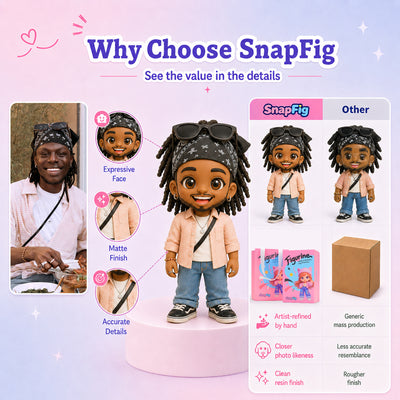
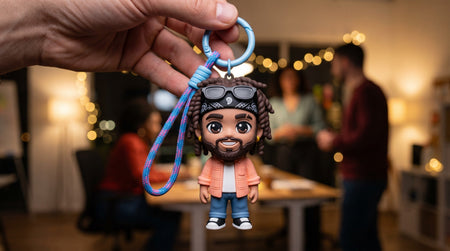
Picture this: you upload a photo of your best friend - the one where she's doing that ridiculous pose she always does - and a few days later, a miniature 3D version of her arrives at your door. Not a flat print. Not a sticker. An actual three-dimensional sculpt with volume and weight, rendered in a cute Chibi or smooth Pixar-like style, and printed in full color from durable resin.
You pick it up. It's heavier than you expected, cool and solid in your hand, about the size of a thumb. The detail is absurd for something this small - the tiny glasses, the specific jacket, that one crooked smile.
SnapFig turns ordinary 2D photos into these miniature 3D sculptures using AI modeling and high-precision printing. Each layer of resin is cured at roughly 50 microns thick (thinner than a human hair), which means textures like embroidery on a hoodie or the mesh pattern on a sneaker actually show up. The colors are printed directly into the material, not painted on, so they won't chip or fade.
And the packaging matters too. Each piece arrives in a premium gift box designed for the unboxing moment - because that three-second window where they lift the lid and see their own tiny face staring back at them? That's where the oxytocin hits.
From a signaling theory perspective, this is the ultimate "high cognitive effort" gift. You had to choose the right photo, pick a style, and wait for the preview. That process communicates something a store-bought item simply cannot.
Personalized 3D Pet Keychains: The Perfect Gift for Pet Lovers
If you've ever loved a pet, you know the bond is real. It's not a metaphor. For millions of people, their dog or cat is family, full stop.
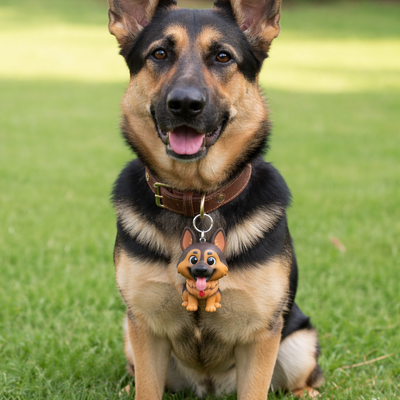
This is exactly why a generic paw-print mug falls flat. It says "I know you have a pet." A 3D sculpted keychain of their specific golden retriever - with the exact coat pattern, the slightly tilted head, that one ear that always flops - says something completely different. It says "I see how much Baxter means to you."
SnapFig's pet keychains are built from the same high-fidelity process: upload a clear photo, get a 3D digital preview for approval, and the final piece is printed in weather-resistant, waterproof resin with heavy-duty metal keychain hardware. The surface has that smooth, dense feel of quality resin - not the hollow, rattly plastic of a cheap novelty item. It can handle being tossed in a bag, clipped to keys, or carried daily without the colors wearing down.
For pet memorial gifts especially, this kind of detail matters. It's the difference between "a nice thought" and something that makes someone's breath catch when they open the box.
Ready to turn a favorite photo into a 3D miniature your loved one will carry everywhere? Head to SnapFig and upload your photo. You'll get a free 3D digital preview before anything goes to print - so what you see is exactly what you get.

📸 How to Choose the Perfect Photo for a Custom 3D Gift
The quality of your reference photo makes a real difference in the final result. Here are four tips to get the best output:
- Prioritize clear, even lighting. Natural daylight works best. Avoid heavy shadows across the face or harsh overhead lighting that flattens features. If the photo was taken in a dim restaurant, it's probably not the one.
- Pick a photo with a distinctive outfit or prop. The more specific, the better. That favorite leather jacket, the worn-out baseball cap, the guitar they never put down - these details are what transform a figurine from "a person" into "that person."
- Capture a genuine expression. Stiff, posed smiles don't translate well into 3D. The best figurines come from candid shots - the mid-laugh, the focused stare, the goofy face they make when they think no one's watching.
- For pets: get a clear side or three-quarter angle. Straight-on photos of pets tend to lose depth. A slightly angled shot that shows the shape of the ears, the curve of the snout, and the body posture gives the AI much more to work with.
🎁 What Your Next Gift Says About You
The psychology is straightforward. The gifts people treasure are the ones that prove someone was paying attention. Not the ones wrapped in the most expensive paper.
Every time you default to a gift card or a "safe" generic option, you're leaving emotional impact on the table. And every time you invest the cognitive effort to create something personal - something only you could have given because only you know that specific detail about that specific person - you're building a bond that a hundred store-bought presents couldn't match.
SnapFig's custom 3D keychains, figurines, and bag charms exist in that sweet spot: portable enough to be part of someone's daily life, personal enough to trigger a genuine emotional response, and durable enough to last for years.
The next time you're stuck staring at a "Top 50 Gift Ideas" listicle, close the tab. Open your camera roll instead. The perfect gift is probably already in there, waiting to become something you can hold.
Explore SnapFig's full collection of custom 3D keychains and figurines at snapfigures.com.
❓ Frequently Asked Questions
What makes a gift truly meaningful?
It's not about the dollar amount. A gift feels meaningful when the recipient senses that the giver invested thought and attention - not just money. Psychologically, this "cognitive effort" signals genuine care and triggers deeper emotional responses than even expensive generic alternatives.
Are custom 3D keychains durable for daily use?
Yes. SnapFig uses a high-quality, UV-cured resin that's waterproof, scratch-resistant, and colorfast. The colors are printed directly into the material during production rather than hand-painted afterward, which means they hold up through daily handling, weather, and the general chaos of living in someone's pocket or bag.
How long does it take to make a custom 3D figurine?
The production process takes around 15 working days from approval of the 3D preview to delivery. Quality craftsmanship at this resolution isn't instant - each piece is built layer by layer. Factor in 7 to 15 days for global shipping, and you're looking at roughly 3 to 4 weeks total. Plan ahead for birthdays and holidays.
Can I make a 3D keychain from an old photograph?
Absolutely. SnapFig's AI can work with older photos as long as the face and key features are reasonably visible. The team can enhance and reconstruct detail from lower-resolution images. If you're unsure whether your photo will work, you can upload it and receive a free 3D preview before committing.