
The email lands in early March with no brief attached: you are picking the employee gifts this year, budget to follow.
By the fifth supplier site the catalog has stopped changing. Insulated tumblers. Backpacks. A gift basket built around three kinds of pretzel. Somewhere in the grid sits a fleece vest, and the only real decision left is which colour of the same object eighty people will unwrap.
None of it is bad. All of it is interchangeable, and interchangeable is the whole problem.
🎁 What Employees Actually Keep
HR people are blunt about this in their own forums. In a thread on r/humanresources about rewarding a team that had worked through an unusually hard stretch, one commenter dismissed branded giveaways in a single line.
"Useless swag is the worst. Here, have this box of garbage..."
The comment it answered described a mailer box of company swag that everyone who received it disliked, for the simple reason that the contents were useless. Nobody in that thread was arguing about budget. They were reacting to an item that had been chosen for a headcount rather than a person.
Recognition is not a soft metric either. Gallup's longitudinal work with Workhuman found that well recognized employees are 45% less likely to have turned over after two years, and that the recognition doing that work is specific and authentic rather than uniform.
The gifts that survive past January share one trait. The recipient is inside the gift.
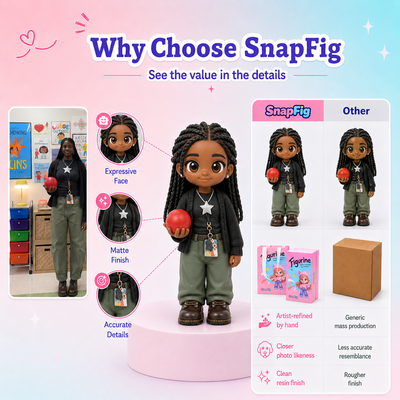
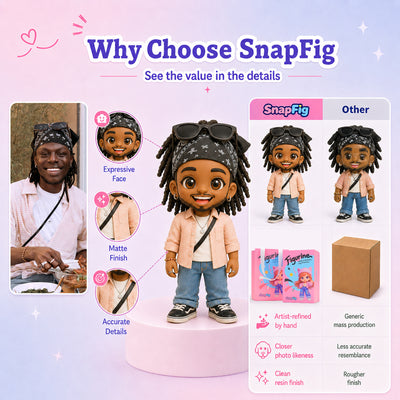
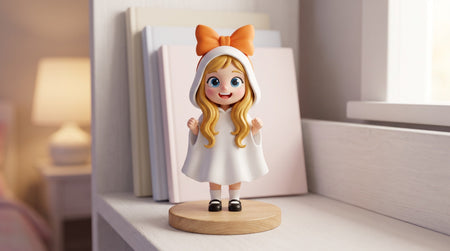
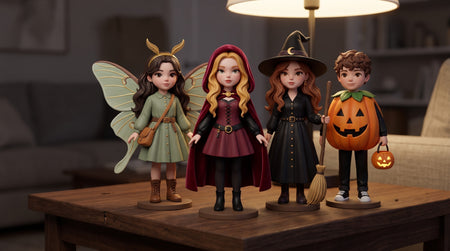
SnapFig works from one photo per person. Each piece is sculpted and hand finished to that individual: their face, their hair, the jacket they actually wear to work. Order fifty and fifty different results come back, which is a different proposition from fifty of the same thing in five sizes.
The object itself holds up. Premium durable resin carries real weight in the hand, cool and solid, nothing like a hollow giveaway. Colour is cured into the surface rather than printed over it, and the clothing and hair are finished by hand, which is why the small details survive being carried around.

The reaction is worth planning for, because it is the part a spreadsheet cannot show you. People do not say thank you first. They turn the thing over, find their own haircut on it, and then start showing the person next to them. Whoever signed off the budget usually hears about it.
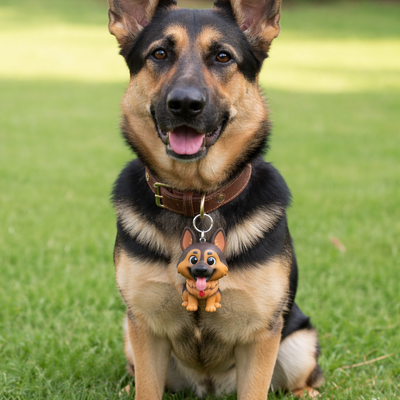
Two formats cover almost every corporate list. The personalized figure keychain is the company-wide option: same sculpture, same likeness work, same size, attached to a keyring instead of a display base. That matters more than it sounds. Hybrid schedules and hot desking mean a large share of any team has no permanent desk for a display piece, and keys go everywhere the person goes.
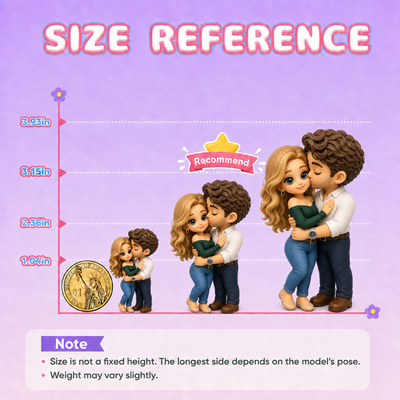
The desktop figurine is the same craft presented as something meant to occupy space on purpose, which is the right register for a promotion, a long service milestone or a farewell. Most companies end up using both, one across the payroll and one for the shortlist. The figure keychain range shows the styles available for the volume tier.
🙋 Is That Too Personal for Work?
This is the question that stops the order, and it usually arrives from whoever has to approve it.
The objection has a legitimate basis. Workplace gifting guidance draws a red line around gifts that are more expensive or more intimate for one person than their peers receive, and around anything that touches appearance, health, family status or private life. Customization carries a second risk that HR knows well: a personalized item can simply miss what the recipient likes.
A likeness keepsake looks like it lands on the wrong side of that line. It does not, and the reason is structural rather than sentimental.
Uniform format is uniform value. Everyone receives exactly the same thing: their own.
Every recipient gets the identical product, the identical process and the identical spend. The only variable is the face, and a face is the one thing nobody can rank against a colleague's. Compare that with the version most companies default to, where each person gets a different item chosen around their interests. That approach invites precisely the comparison an equity policy exists to prevent.
The gap it addresses is well documented. Gallup reports that only 32% of employees strongly agree they receive fair and equitable recognition at work, with the figure lower still for Black and Hispanic employees.
The photo question settles itself in practice. Use what people already show at work: a headshot, a badge photo, a shot from the last offsite. Nothing from anyone's private life needs to enter the order, and a request for a work photo is one an employee can decline without any awkwardness.
The other half of the objection is quieter and harder to answer with a policy: what if the likeness is wrong. A gift that misses the person is worse than a tumbler, because it was clearly trying. That risk is handled before anything physical exists.
If the policy needs signing off before you commit budget, the bulk order team can put the spec, the preview process and the equity logic in writing first.
Same product, same spend, a different face on every one. Bring your headcount and we will put the spec in writing before it goes to HR.
Talk to Our Business Team →🧾 The Gift Card Tax Problem
The gift card is the obvious escape from all of the above. Payroll already knows why it is not.
The IRS is unambiguous on cash equivalents. Its guidance on de minimis fringe benefits states that cash or cash equivalent items provided by the employer are never excludable from income, and that gift certificates redeemable for general merchandise or carrying a cash equivalent value are not de minimis benefits and are taxable.
That leaves two routes, and neither reads well internally. Pass the liability to the employee, and the thank you shows up as a smaller paycheck. Gross it up, and the recognition budget quietly funds a tax bill instead of a gift.
A tangible keepsake sits in a different category from a cash equivalent. Treat that as a qualitative difference and nothing more. Value, frequency and how the program is run all feed into the answer, and the dollar figures that circulate in HR forums trace back to rulings in particular cases rather than to a general allowance anyone can rely on.
SnapFig does not give tax advice. Confirm with your finance team or tax advisor how any gift program should be recorded before the budget is committed.
📆 When You Only Need a Few at a Time
December is one week of the year. The rest of the calendar hands out gifts one at a time: a start date, a probation pass, a promotion, a first anniversary, a farewell that gets planned in a hurry.
Each one is too small to justify a quote on its own, which is how they end up on somebody's personal card and out of the recognition budget entirely.
The standard answer to that pattern is to hold stock and top it up. Buy a case of tumblers, keep them in a cupboard, reorder when the shelf looks thin. For generic items it works.
For custom items it falls apart, and the advice itself admits as much. The usual version tells buyers not to warehouse anything sized, highly customized, fragile or expensive, and to use an on-demand supplier instead. Then it stops there. No on-demand supplier can produce a piece built around one individual's photo, because that photo does not exist until the person does.
SnapFig closes that gap from the other end. Place the batch once at fifty units or more, then release it across the year as recipients appear. Nothing sits in a cupboard, because nothing has been crafted yet.
It is not inventory. It is an allowance you draw down as the year produces people to thank.
The practical effect is one approval instead of twelve. One purchase order, one agreed price, one supplier record in the system, and photos sent through whenever someone joins, gets promoted or hits a milestone. How the batches are spaced is set with your dedicated account manager in the quote, since it depends on quantity, product and how quickly photos come back.
It also lets one budget line cover moments that normally get handled by four different people with four different card receipts.
Week one, and the first year
New starters and probation passes come in ones and twos and never on a schedule. The keychain tier suits this: light to post, easy to carry on day one, and it does not assume the person already has a desk.
Promotions and anniversaries
These are the moments people photograph and put on a shelf. A figurine on a display base carries the weight the occasion has, and it stays visible long after the announcement email has scrolled away.
Project close and team wins
A launch ships, a migration survives, an account gets saved. Drawing five pieces from an existing batch means recognition lands while people still remember the week that earned it.
Farewells and long service
Someone leaves after six good years and the leaving card gets signed in a rush. A likeness piece is the version of that card people keep, and it does not need a rush order to exist.

🛒 What Procurement Will Ask
Three questions decide whether this clears the internal process, and none of them are about the product.
Minimum order and volume pricing
Fifty units. Below that, ordering from the main SnapFig store at retail is faster than running a quote. Above it, volume pricing applies at 10% from 50 to 99 units, 15% from 100 to 199, and 20% from 200 up.
Purchase orders, invoices and payment
All supported. Formal invoices, purchase orders and bank transfer mean the order clears procurement the same way any other approved supplier does, rather than landing on someone's corporate card. Payment is in full up front rather than on terms, because custom crafting starts as soon as you approve the previews, and quotes already include shipping and duties.
Shipping to each employee
Send one address list and each keychain or custom figurine is dispatched directly to that person's home. For distributed teams this is the difference between a gift arriving and a gift waiting in an empty lobby.
Everything between those three answers, the photo collection, the digital preview on every unit and the per-recipient dispatch, runs through one account manager. If you are pricing holiday gifts for teams specifically, or comparing bulk gifting solutions on the mechanics alone, the December ordering timeline and the full bulk workflow are covered end to end in a separate article, including the sample stage and how far ahead to start.
Start a bulk quote with three things: headcount, whether you want the keychain, the figurine or a split across both, and roughly when the first release needs to land.
The catalog in that fifth browser tab is not wrong about what a gift costs. It is wrong about who the gift is for. Eighty identical tumblers say the company remembered it had eighty employees. Eighty different faces say it remembered who they were.
- One photo per employee, so no two pieces in a batch are alike
- A digital preview on every single unit, approved by you before any crafting starts
- Bulk orders from 50 units, with volume pricing at 50, 100 and 200 units
- Order once and release the batch across the year as people join, get promoted or move on
- Purchase orders and formal invoices supported, with delivery to each recipient's home
Send your headcount, whether you want keychains, figurines or a split across both, and when the first release needs to land. A dedicated account manager prices the batch and confirms the schedule from there.
Request a Bulk Quote →Frequently Asked Questions
What are the best corporate gifts for employees?
The ones that could only have gone to that one person. A keepsake made from an employee's own photo outlasts drinkware and gift baskets, and it covers a whole team because every unit in the order comes out different.
Are personalized gifts appropriate for the workplace?
Yes, as long as the personalization comes from work rather than private life. A likeness built from a headshot or a team photo reads as thoughtful in any office, and every recipient gets the identical product at the identical spend.
Are employee gifts taxable?
Depends on the form the gift takes. The IRS states that cash and cash equivalent items, which covers most gift cards, are never excludable from income, while tangible items are assessed on different criteria. Confirm the treatment with your finance team or tax advisor.
What is the minimum order for custom 3D printed gifts for employees?
50 units. Below that, ordering from the main SnapFig store at retail is quicker than running a quote. Volume pricing starts at 50 units and improves again at 100 and 200.
Can we order once and send the gifts out over the year?
Yes. Place one order of 50 units or more, then release it in batches as people join, get promoted or reach a milestone. Nothing has to be warehoused, because each piece is crafted when you call it off.
Can every gift in the order be different?
Yes. Each piece is built from one individual's photo, so an order of a hundred contains a hundred different faces. This is the default way SnapFig runs employee orders.
Can you add our company logo?
Yes. Your logo can sit on the display base or on the packaging, and branded or white label gift boxes are available at higher quantities.
Do you accept purchase orders and invoices?
Yes. Purchase orders, formal invoices and bank transfer are all in place, so the spend can be raised against a cost centre instead of somebody's card. Payment is in full up front, since custom crafting starts once you approve the previews.
Can you ship to each employee's home address?
Yes. One address list is enough, and each piece is dispatched to the individual rather than to a central office. For a distributed team that is usually the only delivery route that works.
How do we collect photos from a large team?
Through one shared upload link. Your HR or admin contact circulates it once and each person adds their own photo, which keeps the whole collection out of email threads and spreadsheets.