You took the test. Maybe it was 2 AM on a Tuesday, or during a lunch break when you should've been answering emails. Sixteen questions later, four letters appeared on your screen. INTJ. ENFP. ISTJ. Whatever it was, you felt something click.

For about ten minutes, you felt seen.
You're not alone. Over 2 million people take the MBTI assessment every year, searching for that same moment of recognition. That instant when someone finally puts words to why you think the way you think, why you recharge the way you recharge, why the world feels different to you than it does to everyone else.
Then you closed the browser tab. Life continued. The insight faded into the background noise of a thousand other personality quizzes you've taken and forgotten.
But here's the thing that bothers me. When you want to celebrate that moment of self-recognition, or when you want to gift it to someone who finally understands why they think differently, what does the market offer you? A $12 mug from Amazon that'll chip after three washes. A polyester t-shirt with pixelated text. Plastic keychains that feel like they came from a gumball machine.
Here's what the market tells us: more than 65% of consumers actively prefer personalized gifts over generic ones. They want something that reflects who they are. Yet somehow, the MBTI merchandise industry decided that "personalized" means slapping four letters onto the cheapest product they could source from Alibaba.
This lazy merchandising doesn't match the weight of what those four letters represent. An INTJ's strategic mind deserves better than a coffee mug. An ENFP's boundless energy deserves more than a mass-produced poster.
It's time we fixed that.
Not Just a Toy, But a Totem
I'll tell you where SnapFig started. Our founder, Feihu, is an INTJ. Classic architect personality. He wanted something on his desk that represented that identity. Not as decoration. As a reminder.
He searched everywhere. Etsy gave him wooden blocks with laser-etched letters. Redbubble offered him stickers. Amazon had those hollow vinyl figures that cost $8 and look like they were designed in Microsoft Paint circa 2003.
Nothing had weight. Nothing had permanence. Nothing said "I understand the complexity of human psychology, and I'm honoring it."
So we built it ourselves.
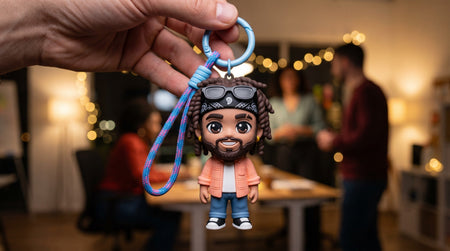
What we created isn't a toy you toss on a shelf and forget. It's a physical anchor for self-reflection. When you're stuck on a decision, when you're doubting your instincts, when the world is telling you to be someone you're not, you glance at your desk. There it is. Your architect. Your advocate. Your commander.
It doesn't talk. It doesn't need to. It reminds you of your strengths in a way no app notification ever could.
Picture this: You're working late. The kind of late where every decision feels wrong. You look up from your laptop, and there's that figure. The one that represents your core self. Suddenly, you remember. You're not broken for wanting alone time (INTJ). You're not "too much" for feeling everything deeply (INFP). You're not weird for seeing patterns others miss (INTP).
You're exactly who you're supposed to be. That's not decoration. That's a daily conversation with the best version of yourself.

The Unboxing: A Ritual Worth $29 (Values Included)
Most gifts arrive in a condition I'd describe as "survived shipping." Plastic wrap. Cardboard. Maybe some bubble wrap if you're lucky. You rip it open, glance at the thing inside, and within an hour it's wherever you put things you don't know what to do with.
We refused that experience.
When your SnapFig arrives, you'll notice the weight first. This isn't a padded envelope. It's a gift box that cost us $29 to design and produce. Magnetic closure. Embossed details. The kind of packaging you don't throw away because it feels wrong to waste something that beautiful.
Open it. Inside, your personality figure rests in a custom foam insert. Not rattling around. Not wrapped in tissue paper. Cradled. Protected. Respected.
This is the moment where cheap gifts reveal themselves. They arrive damaged, or they look worse in person than they did online, or they feel hollow in your hand. Your brain makes a split-second judgment: "This person didn't really care."
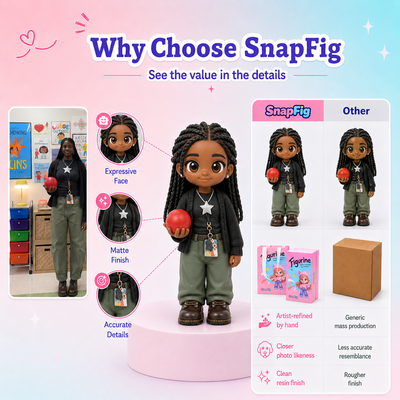
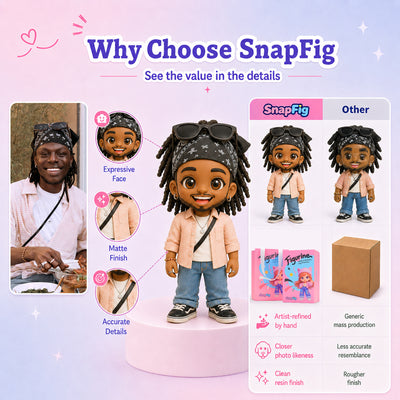
But when you lift a SnapFig out of that box, when you feel the actual heft of the resin, when you see the color accuracy and the crisp details, something different happens. You realize this wasn't an afterthought. Someone spent real time thinking about what you'd appreciate.
That's why people keep the boxes. I've seen customers use them as desk organizers, as jewelry boxes, as places to store the things that matter. The box itself becomes part of the gift, because we treated it like it mattered. Because it does.
Why "Good Enough" Wasn't Good Enough
Let's talk about why most 3D printed figures look terrible.
The cheap ones use a technology called FDM (Fused Deposition Modeling). It's the kind of 3D printing you've seen at schools or makerspaces. It works by squeezing melted plastic through a nozzle, layer by layer, like a hot glue gun controlled by a robot.
The result? Visible lines. Rough texture. Colors that fade because they're painted by hand afterward. You can see every single layer if you look close enough, like geological strata in a cliff face.
We don't use that.
SnapFig figures are made with industrial-grade PolyJet resin technology. Instead of melting plastic, we cure liquid resin with UV light.
Layer thickness: 16 microns.
Comparison: A human hair is about 70 microns thick.
Run your finger across the surface. It's smooth. Not "pretty smooth for 3D printing" smooth. Actually smooth. Like phone screen glass. Like polished stone.
The colors aren't painted on. They're printed directly into the material. That means no chipping. No fading. No wondering if it'll survive being on a sunny windowsill.
I'm not saying this because I think you care about microns or UV curing. I'm saying it because when you hold one of these in your hand, you'll notice. Your brain will register "expensive" before you consciously think about it. The weight, the finish, the precision—these aren't things you can fake.
You know those moments when you pick up a product and immediately understand why it costs what it costs? When an iPhone feels different from a budget Android, when a hardcover book feels different from a paperback, when real leather feels different from pleather?
That's what we're aiming for. That instant recognition of quality.
Because your personality type isn't a joke. It's not a fun little quiz result. It's how you process the world. It deserves to be represented by something that matches its significance.

Limited First Batch: Secure Your Identity
Here's the part where I have to be honest about our constraints.
We can't make these fast. The printing process alone takes 18 hours per batch. Quality control adds another day. We're a small team that refuses to cut corners, which means our output is limited.
This is the first edition of the SnapFig MBTI collection. We're launching with 500 units total across all sixteen personalities. Once they're gone, the next batch won't ship for six weeks.
I'm telling you this not as a marketing tactic, but as a logistical reality. We're not Amazon. We don't have warehouses full of inventory. What we have is a workshop, a handful of incredibly skilled technicians, and a promise that every single piece meets our standard.
If you've been putting off buying something meaningful for yourself, or if you know someone whose birthday is coming up and you're tired of giving them another gift card, now's the time.
This isn't about being a protagonist in someone else's story. It's about having a physical reminder of your own story. The one where you're exactly as analytical, creative, spontaneous, or structured as you need to be.
Whether you're buying for yourself or for that friend who finally understands why they've always felt like an outlier, this is what I'd call an ultimate psychology gift. Not because it's expensive. Because it acknowledges something most gifts ignore: the complexity of who we are.
Your personality isn't background information. It's the lens through which you experience everything. It deserves better than a mug.