When you commission a custom figurine, you're not just buying a shape. You're buying a preservation method. A time capsule. A promise that this moment won't fade, crack, or turn into dust in five years.

Most people obsess over whether it "looks like them." They send seventeen different photos from different angles. They argue about whether the smile is accurate. But they completely ignore the most critical question: what is this thing actually made of?
Here's the uncomfortable truth. Ninety percent of custom figurine sellers are using materials that were designed for hobby projects, not heirlooms. They call it a "realistic figurine" when it's actually polymer clay baked in a home oven. They advertise "full-color 3D printing" but hand you something with the texture of sandpaper.
This isn't about aesthetics anymore. It's about Material Science. Let's break down what you're actually getting when you pay for a custom piece, starting with the bottom of the barrel and working our way up to the only option that makes sense if you care about quality.
🧱 The Hobbyist Tier: Polymer Clay
Walk into any craft store and you'll find it. Polymer clay. Sculpey. Fimo. It's the same stuff kids use in art class, except now someone's charging you $200 to hand-sculpt your face with it.
The process is exactly what you think. An artist stares at your photo, pinches some clay, shapes it with their fingers, adds details with a toothpick or sculpting tool, then bakes it in an oven at around 275°F. That's it. No lasers, no precision machinery, just human hands and heat.
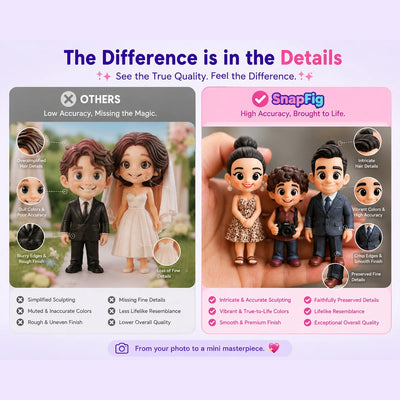
Can it look good? Sometimes. If you hire a genuinely talented sculptor, they can create something charming. But here's what they can't do: capture micron-level detail. The texture of skin. The individual strands of hair. The subtle asymmetry that makes a face actually look like your face and not a generic cartoon version.
Your fingerprints leave marks. The clay has limits in how thin you can stretch it before it tears. Wrinkles in clothing become smooth, generic folds. Eyes lose their depth. What you end up with is a caricature. Which is fine, if that's what you wanted. But if you expected photorealism, you're going to be disappointed.
Then there's the aging problem. Polymer clay manufacturers claim their material "doesn't expire" if stored properly, but that's for uncured clay in a package. Once baked, the reality is different. According to industry research, polymer clay can become brittle after several years of exposure to temperature fluctuations and humidity. While it won't biodegrade quickly, it gradually loses flexibility and develops stress cracks at weak points.
It's a craft project. Not a bad thing, just not what most people think they're paying for when they see the word "custom figurine."
⏳ The Outdated Tech: Sandstone and Gypsum
Now we're in the realm of actual 3D printing, but we've time-traveled back to 2015. This is the era of powder-based printing, also called CJP (ColorJet Printing). The machine spreads a thin layer of gypsum or sandstone powder, then sprays colored binder on top to glue it together. Layer by layer, your figurine emerges from what looks like a sandbox.
The problem shows up the second you touch it. The texture is grainy. Not subtly grainy. Sandpaper grainy. Run your finger across the "skin" and it feels like you're petting a cat's tongue. Every surface has visible grains because that's literally what it is - thousands of tiny particles stuck together with glue.
Detail? Forget it. The powder particles are too large to capture fine features. Skin looks porous. Fabric looks rough. If you're printing a face, good luck with the smoothness around the eyes and lips.
But the real deal-breaker is water. Gypsum is hygroscopic. It absorbs moisture like a sponge. Leave it in a humid room and the colors start to bleed. Try to clean off dust with a damp cloth and you'll watch the binder dissolve in real time. Drop it? It shatters. This material has the structural integrity of chalk.
Some companies coat it in a protective layer to help, but that just makes it feel plasticky and cheap. You can't win with sandstone. It was a stepping stone in 3D printing history, and it should have stayed there.
🖨️ The Prototyping Tier: FDM Plastic (PLA)
This is what most people picture when they hear "3D printing." A nozzle squirts out melted plastic filament, like a very precise hot glue gun, building up your figurine one layer at a time. You've probably seen this if you've ever watched a YouTube video about "making stuff at home."
The prints come out with layer lines. Always. According to 3D printing resolution standards, consumer FDM printers typically operate at 100 to 200 microns - that's 0.1 to 0.2 millimeters per layer. For reference, a human hair is about 70 microns thick. So each layer of your "figurine" is nearly twice as thick as a strand of hair.
For prototypes or mechanical parts, this is fine. For a human face? It's a disaster. The layer lines destroy any illusion of smooth skin. Hair looks like stacked pancakes. If you want it to look decent, you'll need to spend hours sanding it down by hand, priming it, painting it. At that point, why are you even using a 3D printer?
Oh, and PLA filament comes in single colors. Want a realistic skin tone? You're hand-painting it. Want the exact shade of your blue shirt from that wedding photo? You're mixing acrylics and hoping for the best. The paint will chip. It always does.
🏆 The Gold Standard: Industrial Full-Color Resin
Here's where we stop compromising. This is the technology SnapFig uses.
PolyJet technology works like an inkjet printer, except instead of spraying ink onto paper, it's spraying microscopic droplets of liquid photopolymer resin onto a build platform. Each droplet is measured in picoliters. The layer thickness? Between 16 and 30 microns. That's up to ten times finer than consumer FDM printing, and thinner than a human hair.
After each layer is sprayed, a UV light instantly cures it. Solid. Locked in place. The next layer goes on top. Repeat this process a few thousand times and you have a figurine with a level of detail that's physically impossible with any other consumer method.
But the real magic is in the color. This isn't paint. The color is embedded directly into the resin itself during printing. The machine mixes cyan, magenta, yellow, black, and white resins in real time, creating millions of possible color combinations. Your skin tone isn't approximated - it's chemically precise. The blush on your cheeks? That's a gradient of resin droplets transitioning from one tone to another at a microscopic level.
This is how you get subsurface scattering. That subtle translucency that makes skin look alive instead of plastic. Light penetrates the surface layer slightly before reflecting back out, just like real human skin. You can't fake this with paint.
Want transparent elements? Done. Eyeglasses with actual clear lenses. Wedding veils with a realistic sheer quality. Jewelry with gemstone-like clarity. Only resin can do this because only resin is cured as a solid mass, not assembled from particles or painted after the fact.
The physical properties matter too. This isn't brittle like sandstone or soft like clay. Industrial-grade resins can achieve tensile strength ratings up to 8,000 psi, comparable to engineering-grade plastics. You can drop it. It won't shatter. You can apply pressure. It won't dent.
And here's the part that separates resin from everything else: it's fully waterproof and UV-resistant. According to durability studies, properly cured engineering-grade resin prints can maintain their integrity for 10 to 15 years under normal indoor conditions, far exceeding the 3 to 5 year lifespan of standard materials. Your figurine gets dusty after sitting on a shelf for six months? Run it under the tap. Use soap if you want. The color won't fade, bleed, or wash away because it's not a coating. It's the material itself.
This is the difference between a souvenir and an artifact. Between something that lasts a few years and something you can pass down to your kids.
The Real Cost of Cheap Materials
I get it. Polymer clay figurines cost $60. Resin figurines cost $100. The price gap is real.
But here's what you're actually comparing. One is a handmade craft that will look charming on your desk for a while until it cracks or you get tired of the cartoonish style. The other is a precision-engineered object that will look identical in twenty years to the day you received it.
You're not paying for "better." You're paying for permanence. For accuracy. For the peace of mind that this memory you're trying to preserve won't degrade, discolor, or disappoint.
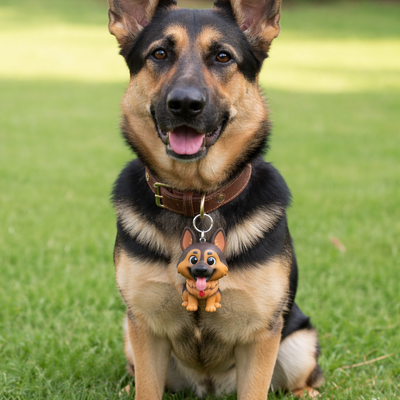
Some moments deserve polymer clay. Birthday parties, fun gifts, quirky desk toys. But weddings? The last photo of your dog before he passed? Your grandmother's face before dementia took her smile? Those aren't "craft project" moments. Those are "museum-quality archive" moments.
SnapFig uses industrial-grade full-color resin because we're not interested in making toys. We're in the business of freezing time. And time doesn't care about your budget - it only cares about whether the material you chose can outlast it.
If you're ready to see what resin can actually do, stop comparing prices and start comparing what you're getting. Because in ten years, the cost difference won't matter. The only thing that will matter is whether your figurine still looks like the person you were trying to remember.