There is a ritual most of us perform without thinking. Every morning, before you leave the house, you make a series of small, deliberate choices. You pick a wallet that fits your back pocket just so. You choose a watch that works with whatever you are wearing. You select a pen, a bag, a key fob - and each of these decisions, however minor they feel, says something about who you are and what you care about.

Then you grab your phone. And you wrap it in whatever case Amazon suggested during a 2 a.m. scroll session.
That contradiction is worth sitting with for a moment. Your smartphone is the single object that never leaves your hand. It is in more photos than your face is. It sits on every meeting table, every restaurant counter, every first date. And yet most people treat the case as an afterthought - a utilitarian sleeve for a thousand-dollar piece of glass, chosen for its star rating rather than its story.
A phone case should be more than armor. It should be the most personal object in your everyday carry.
🎒 The Minimalist Movement Has a Personality Problem
The past decade of product design has been a long, slow purge of ornamentation. Clean lines. Neutral tones. "Letting the material speak." And there is real beauty in that philosophy - until everything starts to look the same.
Walk into any office, any coffee shop, any departure lounge, and you will see the same landscape: matte black MagSafe cases, clear silicone that has already started to yellow at the edges, and the occasional brand logo case that announces loyalty to a company rather than anything personal. Functional. Forgettable.
The shift happening now in everyday carry aesthetics is a quiet rebellion against that sameness. People are not abandoning minimalism exactly - they are demanding that their minimal objects carry meaning. A mechanical watch is not just a timepiece; it is a story about craft and precision. A slim leather cardholder is not just storage; it is the specific patina from three years of back-pocket use. The object matters less than the narrative attached to it.
This is the gap that custom tech accessories have failed to fill, until recently. Standard personalization - a monogram here, a photo print there - never quite crossed into genuine self-expression. The surface was always flat. And flat, it turns out, is the problem.

✋ Touch Remembers What Eyes Forget
Here is something worth considering about modern digital life. You have probably taken tens of thousands of photos. They live in a cloud, sorted by date, occasionally surfaced by an algorithm offering you "memories" from three years ago. You look. You feel something. You keep scrolling.
The image never quite reaches you, because it was never designed to be touched.
There is a reason tactile experience creates a different category of memory than visual experience. When you run your thumb across a raised surface, you are not just seeing a texture - you are registering it through pressure, temperature, and micro-friction in a way that flat imagery simply cannot replicate. This is why a handwritten letter feels more personal than an email with identical words. It is why a physical book creates a different relationship with its content than a screen does. The body remembers what it has touched.
The concept behind a truly personalized 3D embossed iPhone case is not novelty. It is this: your most-used object, carrying a memory you can actually feel. Not a flat print of your dog's face, but the specific raised contour of his snout. Not a photo of a mountain range you hiked last summer, but the ridgeline itself, mapped in relief under your fingertips as you reach for your phone in the dark.
That is the difference between a unique photo phone cover and a keepsake you will never willingly give up.

⚠️ Why Standard Custom Cases Have Always Fallen Short
Most custom phone cases are a compromise dressed up as personalization. You upload a photo, the service wraps it in ink on a flat substrate, and three months later the edges are peeling and the colors have washed out in your pocket.
The problems are structural. Flat printing sits on the surface of a case rather than being part of it. That means every day of friction, every pocket full of keys, every face-down placement on a concrete table degrades the image incrementally. What started as a crisp portrait of your grandmother becomes a ghostly smudge by the holidays.
Beyond durability, there is the sensory issue. A flat print gives you the visual information of a photograph without adding anything new. You already have the photograph. A premium tactile accessory should do something a photograph cannot: give the image a physical dimension, a surface geography, something to return to with your hands as well as your eyes.
Relief work - raising select elements of an image into a multi-dimensional surface - is a genuinely different category of object. The raised texture adds grip. It changes how the case feels in your palm. It creates a visual hierarchy that draws the eye to what matters. And because the texture is part of the material rather than applied on top of it, it does not peel, fade, or wear away under daily use.
This is the standard that a truly bespoke, tactile accessory needs to meet. Anything less is just a slightly more expensive version of the same flat compromise.

📱 SnapFig's Personalized 3D Embossed iPhone Case
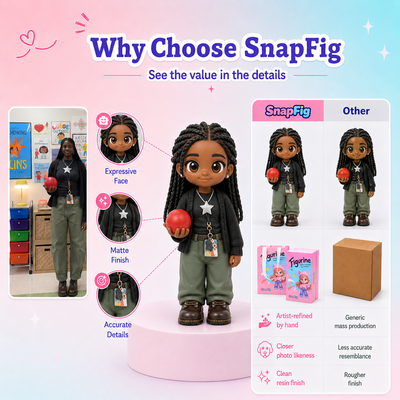
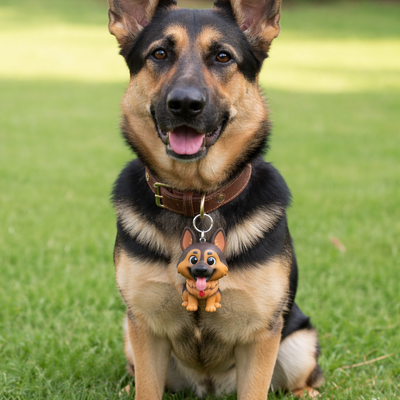
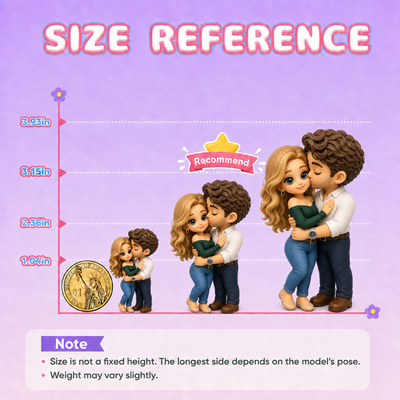
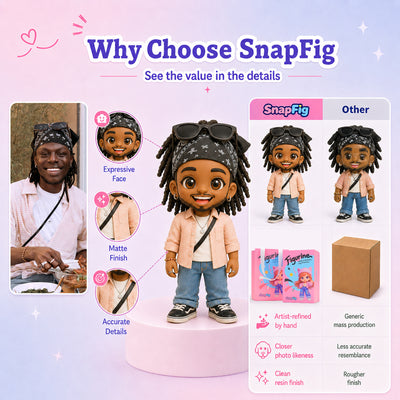
SnapFig built its reputation on one specific problem: the distance between a photograph and a physical object you actually want to own. The same philosophy behind its figurine line - upload a photo, receive something tangible and lasting - now extends to how you carry your phone.
The process is straightforward. You submit a photo. SnapFig's production system maps the depth and contour data from that image and constructs a relief surface on the case, raising the key elements - a face, a skyline, a pet's profile - into a textured, three-dimensional form. The result sits in your hand with a satisfying solidity. The raised portions have a slight cool resistance when you first touch them, firmer than standard silicone, with enough grip that the case stops feeling slippery in the way most phone cases do.
The edges are finished in a soft, drop-absorbing silicone that handles the practical realities of a pocket-to-pavement fall. The relief work itself is durable by design, part of the case structure rather than a surface application.
For gifting, this is the category that most personalized gifts fail to reach: genuinely unique, physically interesting, and tied to a specific memory the recipient actually has. A photo phone cover made from a couples' trip photograph is not a generic gesture. It is a specific one. The difference is legible immediately.
Use cases worth noting:
- For yourself: Your dog's face. Your child at two years old. A landscape from the trip that changed how you see things.
- For gifting: Anniversaries, birthdays, the kind of occasion where "thoughtful" needs to be more than a word on a card.
🎯 Your Most-Reached-For Object Deserves a Point of View
The logic of everyday carry has always been: the objects you choose every day should be worth choosing. Not just functional - considered. The phone case has spent a decade being the exception to that rule, treated as packaging rather than design.
Stop treating the thing you hold most like an afterthought.
Visit SnapFig and submit your photo. The case ships within a week. What arrives is not a print. It is the memory, raised to the surface, ready to be touched every time you reach for your phone.
That is a different kind of everyday carry.
Design Your Own Phone Case Now
❓ Frequently Asked Questions
How durable is a 3D embossed phone case compared to a printed one?
Because the texture is physically raised into a relief surface rather than applied as flat ink, it won't peel, fade, or wear away under daily use. It is structurally part of the case itself.
What kinds of photos work best for 3D embossed cases?
Photos with clear, distinct subjects - like pets, faces, or prominent landscapes - work best, as SnapFig's system translates these depth elements into satisfying, contoured textures.
How long does it take to receive my custom SnapFig case?
Once you submit your photo, your personalized tactile case typically ships within a week.