📱 Your Camera Roll Is a Graveyard of Good Intentions.
You took 47 photos at dinner last Friday. The lighting was perfect. She laughed at something stupid you said, and you caught it mid-smile - eyes half-closed, wine glass tilted, completely unposed.
That photo is now buried somewhere between a screenshot of a parking spot and a blurry picture of your dog.
Here's the thing about digital memories: we hoard them with zero effort, and that's exactly the problem.
According to data compiled by Photutorial, humanity snapped roughly 1.9 trillion photos in 2024 - with 94% of them taken on smartphones. The average user has about 2,000 photos sitting on their device right now. Not printed. Not framed. Just... stored. Waiting.

We tell ourselves we'll come back to them. Sort through them on a lazy Sunday. Maybe make an album. But we never do. And slowly, the moments that mattered start blending into the scroll, losing their edges, becoming just another thumbnail in a grid of thousands.
A photo on a screen is weightless. You can't hold it. You can't set it on your nightstand and catch it out of the corner of your eye while you're falling asleep. It has no texture, no presence, no permanence.
This article is about fixing that. It's about turning the best moments from your relationship into something you can actually touch - something that takes up space in the real world, the way those memories take up space in your head.
🎟️ Why We Cling to Old Movie Tickets (and What That Says About Us)
Think about what's tucked inside your wallet or jammed in a drawer somewhere. A concert wristband. A boarding pass from that spontaneous weekend trip. A handwritten note on a Post-it that says something only the two of you would understand.
These are objectively worthless. You could throw them away and nothing practical would change. But you don't. And there's a reason for that.
Psychologists have a name for it. Object Relations Theory, rooted in the work of Donald Winnicott, suggests that physical objects act as emotional anchors - tangible connections to people, places, and moments that might otherwise drift out of reach. It's not the ticket stub itself that matters. It's the fact that you can hold it between your fingers and instantly be back in Row 12, screaming the lyrics to your song.
Research published by Clay Routledge and colleagues found that nostalgia triggered by physical objects serves real psychological functions - it creates a sense of meaning and strengthens feelings of connectedness to other people. That dried flower pressed inside a book isn't clutter. It's doing emotional work.
This is especially true for couples who spend time apart. Long-distance relationships survive on FaceTime and text threads, but those are temporary by design - they vanish the moment you swipe away. A physical object sitting on a desk, something you can see every morning without unlocking a screen, acts as a quiet, constant reminder. Not dramatic. Just there.
💡 3 Ways to Pull Your Best Memories Out of the Cloud
Before I get into any specific product, let's talk about the philosophy. Turning digital memories into physical ones isn't a single purchase. It's a mindset shift. Here are three ideas that actually work.
The Modern Memory Box
Forget the shoebox-in-the-closet approach. Get intentional about it. Buy a wooden box - something with a little heft, something that feels like it belongs on a shelf, not hidden under a bed. Then curate it.
Print that one photo from the trip to Portugal. Toss in the receipt from the restaurant where you had your first real conversation. Add the terrible birthday card you made by hand because you forgot to buy one. These artifacts, stacked together, become a physical timeline of your relationship. The texture of a printed Polaroid between your fingertips is fundamentally different from swiping through a camera roll. It slows you down. It makes you sit with the memory instead of scrolling past it.
Recreate the Exact Moment
Pull up your favorite photo together. Study it. Where were you? What were you wearing? What did the air smell like?
Now plan a date that mirrors it. Same restaurant. Same park bench. Same ridiculous matching outfits if that's what it takes. The act of recreating a moment forces you to pay attention to the details you originally captured by accident - and it creates a brand new memory layered on top of the old one.
Commission Something Custom
This is where things get interesting - and where the market is clearly heading.
The global personalized gifts industry was valued at roughly $30 billion in 2024, and multiple market research firms project it will nearly double by the early 2030s. That's not a niche trend. That's a full cultural shift away from generic, mass-produced gifts and toward things that actually mean something specific to the person receiving them.
Canvas prints were the first wave. Then came custom illustrations. But the frontier now is three-dimensional - physical objects that capture a moment from every angle, not just the one the camera happened to catch.

🖼️ Why a 3D Scene Hits Different Than a Photo on a Wall
A framed photo is flat. Literally. You see it from one angle, and that's it.
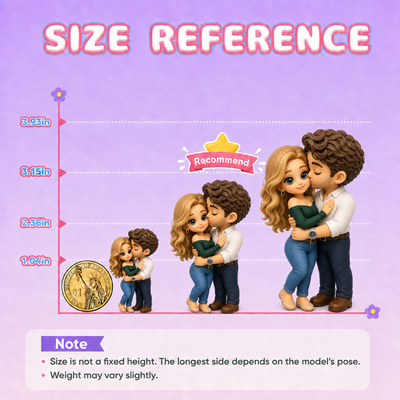
Now imagine a miniature scene - a diorama the size of your hand - that recreates a moment from your relationship in three dimensions. You can rotate it. Pick it up. Notice details you didn't see at first glance: the way his jacket wrinkles at the elbow, the exact tilt of her head, the little imperfections that make it feel real rather than manufactured.
That's the difference between looking at a memory and being pulled into one.
A diorama also does something a photo can't: it becomes an experience. Arranging the tiny props, deciding where the bench goes, positioning the figures just right - that process itself becomes a shared moment. You and your partner end up laughing over it, debating the placement of a miniature flower pot, and suddenly you've created a new memory on top of the one you're preserving.
It's the kind of gift that earns permanent real estate on a bookshelf. Not the kind that ends up in a drawer by February.
🔍 The SnapFig Couple Figurine & Bench Diorama: A Closer Look
If the idea of a 3D memory scene resonates with you, SnapFig's Custom Couple Figurine & Bench Diorama is worth knowing about.
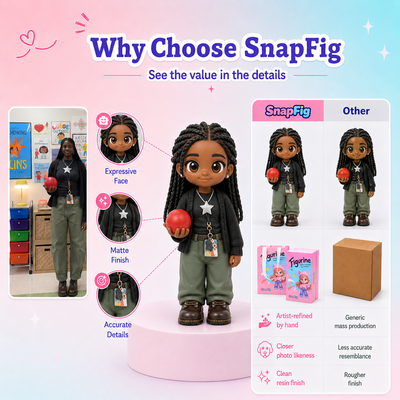
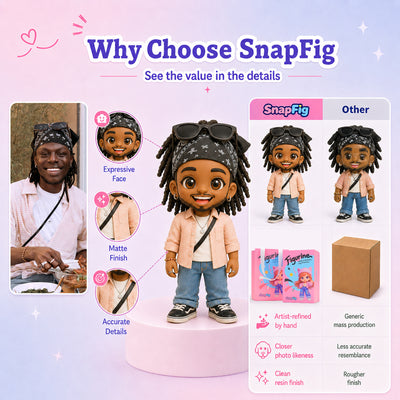
The concept is simple. You upload a photo of you and your partner - standing, sitting, whatever you've got - and SnapFig's AI modeling technology builds a full 3D preview before anything gets printed. You approve it first. No guessing, no crossed fingers, no "I hope it looks like us" anxiety. If the preview doesn't feel right, you adjust. Production only starts after you say yes.
Here's the part that surprised me most: couples don't need the "perfect" photo. The 3D artists can take a standing shot and naturally adapt the poses, outfits, and expressions to fit a seated park bench scene. So that random photo from a friend's wedding where you both looked great? That works.
The figurines themselves are printed in full-color resin - not hand-painted, which means the color doesn't chip or fade over time. The material has a cool, smooth weight to it when you pick it up. It feels solid in your hand, nothing like the hollow plastic of mass-produced figurines.
What makes it a diorama and not just a figurine is the setup. The bench, the flower pot, the miniature street sign - they're all freestanding pieces. You arrange them yourself. It's like assembling a tiny world that belongs exclusively to you and your partner.
The whole scene sits on an engraved wooden base where you can add names, a date, or even GPS coordinates of a meaningful location. If you're celebrating a 5th anniversary, the wooden base practically writes its own story - wood is the traditional gift for year five.
The production takes about a week, and shipping runs 7 to 15 days globally. SnapFig also backs every order with a 90-day quality guarantee and a 1-year warranty on materials.

⏳ Your Camera Roll Is Waiting
Open your phone right now. Scroll back three months. Find the photo that makes you pause - the one that still carries a little weight in your chest.
That photo deserves more than a 4-inch screen. It deserves a place in the physical world where it can sit quietly, collecting dust and meaning in equal measure, reminding you both of exactly who you were in that moment.
The best relationship milestones aren't the ones you post. They're the ones you preserve.
❓ Frequently Asked Questions
How long does it take to make and ship a custom SnapFig diorama?
Production typically takes about a week. After the 3D model is approved and printed, global shipping runs between 7 to 15 days.
Do we need a photo of us sitting down for the bench diorama?
No, you don't need a perfectly posed photo. SnapFig's 3D artists can adapt a standing photo and naturally adjust the poses, outfits, and expressions to fit the seated park bench scene.
What materials are used for the figurines?
SnapFig prints these keepsakes using full-color resin. This means the color is embedded into the material rather than hand-painted on the surface, preventing chipping or fading over time. It also gives the figurine a premium, solid weight.
Will I get to see what it looks like before it is printed?
Yes! SnapFig provides a full 3D preview using advanced modeling technology. You have the opportunity to review and request adjustments before approving it for production.